(Competency #4 - RSS Feed)
For the purpose of this blog and ISAR course I am enrolled in, I have selected and provided an RSS feed of Collections Preservation from the Library of Congress - Digital Preservation site.
I chose this specific feed because it provides recent breakthroughs and technology concerning the topic of this blog. This feed is located to the bottom-right of my blog.
Monday, September 28, 2009

ERIC/WorldCat Database Search
How should one go about conducting a search to retrieve the most relevant records to a query? For my ISAR course I will take you step-by-step on my search using WorldCat and Eric databases through the Texas Woman’s University Library website.
In this case, I will be searching on the topic of library services and their trends in public libraries. I chose this topic because it interests me and I have a collaborative paper on this topic that I and group members are working on for another course. With the help of an outline our group has created for our paper, I have some knowledge of the topic and the direction of my search. As mentioned earlier, for my searches I used both Eric and WorldCat databases.
ERIC DATABASE
Performing my first search using Eric database, I used “library services”[abstract] and “public library” [subject]. Utilizing the advanced search, I entered the phrase “library services” and selected [abstract] as my index. I also wanted to results to include “public library”, and did so by selecting the Boolean operator [and] and by selecting [subject]. This retrieved 5,125 records or hits using these two phrases and the Boolean operator.
To refine my search to include only recent publications, I chose to refine my search by limiting my results to the publication year of 2009. This was selected to obtain the most current information. This gave me a refined total of 5 records!
Among the 5, I chose this record:
In my search using the WorldCat database, I used “library services”[title] and “public library” [keyword]. Utilizing the advanced search, I entered the phrase “library services” and selected [title] as my index. I also wanted to results to include “public library”, and did so by selecting the Boolean operator [and] and by selecting [keyword]. This retrieved 3,956 records or hits using these two phrases and the Boolean operator.
To narrow down the results, I limited the search to include results with the publication year 2009 and “library services” in the abstract. This retrieved 29 records, but none were relevant to my topic of interest.
Instead, I changed the phrase “library services” to “library program”. Subject field was used for library program, and same field was used for public library [keyword]. This pulled a list of 218 records. I limited the search to just records with the publication year of 2009; this retrieved a total of 2 records!
Among the 2, I chose:
In this case, I will be searching on the topic of library services and their trends in public libraries. I chose this topic because it interests me and I have a collaborative paper on this topic that I and group members are working on for another course. With the help of an outline our group has created for our paper, I have some knowledge of the topic and the direction of my search. As mentioned earlier, for my searches I used both Eric and WorldCat databases.
ERIC DATABASE
Performing my first search using Eric database, I used “library services”[abstract] and “public library” [subject]. Utilizing the advanced search, I entered the phrase “library services” and selected [abstract] as my index. I also wanted to results to include “public library”, and did so by selecting the Boolean operator [and] and by selecting [subject]. This retrieved 5,125 records or hits using these two phrases and the Boolean operator.
To refine my search to include only recent publications, I chose to refine my search by limiting my results to the publication year of 2009. This was selected to obtain the most current information. This gave me a refined total of 5 records!
Among the 5, I chose this record:
Imagine, Invent, Program, Share: A Library-Hosted Computer Club Promotes 21st Century SkillsWorldCat DATABASE
Author: Myers, Brian Source: Computers in Libraries v29 n3 p6-9, 38-40 Mar 2009 (7 pages) Doc. Type: Article (EJ) Accession No: EJ831235 Libraries Worldwide: 2394 TEXAS WOMAN'S UNIV LIBR See more details for locating this item
In my search using the WorldCat database, I used “library services”[title] and “public library” [keyword]. Utilizing the advanced search, I entered the phrase “library services” and selected [title] as my index. I also wanted to results to include “public library”, and did so by selecting the Boolean operator [and] and by selecting [keyword]. This retrieved 3,956 records or hits using these two phrases and the Boolean operator.
To narrow down the results, I limited the search to include results with the publication year 2009 and “library services” in the abstract. This retrieved 29 records, but none were relevant to my topic of interest.
Instead, I changed the phrase “library services” to “library program”. Subject field was used for library program, and same field was used for public library [keyword]. This pulled a list of 218 records. I limited the search to just records with the publication year of 2009; this retrieved a total of 2 records!
Among the 2, I chose:
Library programs online : possibilities and practicalities of Web conferencing /
Author: Peters, Thomas A., 1957- Publication: Santa Barbara, Calif. : Libraries Unlimited, 2009, Document: English : Book
Libraries Worldwide: 11
Sunday, September 20, 2009
Library of Congress Podcasts
(Competency #3- Podcast)
For my class, I performed several searches using various search engines to help me locate a podcast on or close to digital preservation, but was unsuccessful. The search engines used were those listed in my class (http://www.podcastzoom.com/, http://www.podanza.com/, http://www.podcastsearchservice.com/) and two outside aside from those (http://www.getapodcast.com/, http://www.google.com/). In my efforts, I was lucky to find podcasts that were rarely updated and/or did not pertain to my blog topic. Instead, I found interest in the Library of Congress' podcast available at http://www.loc.gov/podcasts/. Using Google's search engine, Library of Congress' podcast was retrieved in my top results list. The Library of Congress provides three podcasts for anyone to subcribe or browse through and they are: National Book Festival, Slave Narratives, and Music and the Brain.
For my class, I performed several searches using various search engines to help me locate a podcast on or close to digital preservation, but was unsuccessful. The search engines used were those listed in my class (http://www.podcastzoom.com/, http://www.podanza.com/, http://www.podcastsearchservice.com/) and two outside aside from those (http://www.getapodcast.com/, http://www.google.com/). In my efforts, I was lucky to find podcasts that were rarely updated and/or did not pertain to my blog topic. Instead, I found interest in the Library of Congress' podcast available at http://www.loc.gov/podcasts/. Using Google's search engine, Library of Congress' podcast was retrieved in my top results list. The Library of Congress provides three podcasts for anyone to subcribe or browse through and they are: National Book Festival, Slave Narratives, and Music and the Brain.
- National Book Festival Podcasts are interviews of the award-winning authors of books from the festival.
- Slave Narratives Podcasts include both first-source interviews and histories of the hardships of slavery.
- Music and the Brain Podcasts provide lectures, conversations and symposia on new research in cognitive neuroscience and music.
Monday, September 14, 2009
Digital Urban Blog
(Competency #2- Search Blog)
Using Google's Blog search engine, I was able to locate a blog of my interest. The name of the blog is Digital Urban, and just the name itself attracted me. Sort of like shopping for a book; one usually scans and judges a book by its cover. Not only did the name do it, but the most recent published post swept me away...Monopoly City Street. Here is an excerpt of the post from Digital Urban Blog:
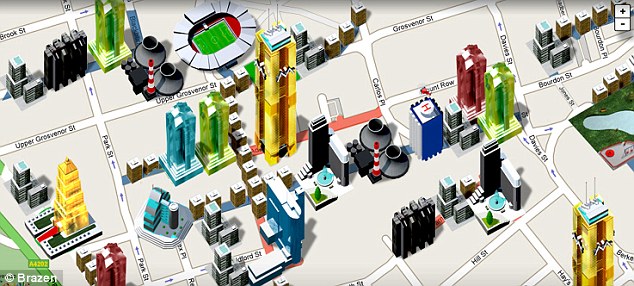 Aside from this very interesting post on Monopoly, I found lists of posts on Google and Google Earth. This blog covers just about everything Google is doing. Here is a clip of what the blog is about (http://digitalurban.blogspot.com/2005/10/about-digitalurban.html):
Using Google's Blog search engine, I was able to locate a blog of my interest. The name of the blog is Digital Urban, and just the name itself attracted me. Sort of like shopping for a book; one usually scans and judges a book by its cover. Not only did the name do it, but the most recent published post swept me away...Monopoly City Street. Here is an excerpt of the post from Digital Urban Blog:
"Google has teamed up with the people behind Monopoly to launch a global online version running on top of Google Maps and perhaps Google Earth (?). Details are scarce at the moment but an announcement is imminent via both the game's official site and the blog."Image obtained from Digital Urban Blog; source: http://www.casa.ucl.ac.uk/andy/blogimages/citystreets.jpg on 9/14/09.
Aside from this very interesting post on Monopoly, I found lists of posts on Google and Google Earth. This blog covers just about everything Google is doing. Here is a clip of what the blog is about (http://digitalurban.blogspot.com/2005/10/about-digitalurban.html): "Digital Urban is written by Dr Andrew Hudson-Smith, aimed at examining the latest techniques to visualise the city scape via digital media it covers a lot of the work going on at the Centre for Advanced Spatial Analysis, University College London."If you are interested, this blog contains an RSS feed. It is also noteworthy to mention that this blog in particular has a whopping 3600 readers and counting! I think you might find something interesting on here. Check it out!
Saturday, September 12, 2009
Related Blog
Using Google's search engine, I was able to locate another blog on digital preservation. Most blogs listed in my search either had no posts related to the topic of my blog, or were "dead" blogs.
Ten Thousand Year Blog, http://davidmattison.ca/category/digital-preservation/
The author, David Mattison who is an archivist and historian in Canada, sheds light on what other organizations, companies, and countries are doing to digitally preserve their materials for future use. His blog dates back from October 2008 with blog posts not just on digital preservation, but from web 2.0 to digital archiving.
Ten Thousand Year Blog, http://davidmattison.ca/category/digital-preservation/
The author, David Mattison who is an archivist and historian in Canada, sheds light on what other organizations, companies, and countries are doing to digitally preserve their materials for future use. His blog dates back from October 2008 with blog posts not just on digital preservation, but from web 2.0 to digital archiving.
Wednesday, September 9, 2009
E-Library - Library 2.0
Breaking news! The Cushing Academy has made a huge leap towards the concept of an e-library. Their 144-year old library decided it was time to rid their collection of printed materials and go digital. Below is an excerpt of the article provided by The Boston Globe, published on September 4, 2009.
"This year, after having amassed a collection of more than 20,000 books, officials at the pristine campus about 90 minutes west of Boston have decided the 144-year-old school no longer needs a traditional library. The academy’s administrators have decided to discard all their books and have given away half of what stocked their sprawling stacks - the classics, novels, poetry, biographies, tomes on every subject from the humanities to the sciences. The future, they believe, is digital."
A Library Without the Books Article
(Source accessed on 9/9/2009)
"This year, after having amassed a collection of more than 20,000 books, officials at the pristine campus about 90 minutes west of Boston have decided the 144-year-old school no longer needs a traditional library. The academy’s administrators have decided to discard all their books and have given away half of what stocked their sprawling stacks - the classics, novels, poetry, biographies, tomes on every subject from the humanities to the sciences. The future, they believe, is digital."
A Library Without the Books Article
(Source accessed on 9/9/2009)
Cathy on Digi-Preserv

(Competency - Image)
To view the image properly and with better quality, visit the link provided below.
Image derived from the Library of Congress site, Cartoon Image
, and from Universal Press Syndicate.
Accessed on 9/9/2009
The Library of Congress
A website filled with helpful links, information, and tools on digital preservation. Dive in to discover more on digital preservation:"Library of Congress: Digital Preservation"
Also, located on the bottom left-side of this homepage, there is a link to a short presentation on digital preservation. Check it out!
Also, located on the bottom left-side of this homepage, there is a link to a short presentation on digital preservation. Check it out!
Friday, September 4, 2009
Introduction and Purpose
(Competency #1-Intro & Purpose)
Welcome to the Digital Preservation blog! This blog was created to compile my competencies of Information Storage and Retrieval. Designed for my Information Storage and Retrieval course, I will share and publish items learned throughout the course along with other helpful links.
I am currently employed at a public library working in the public services at the circulation desk. I am drawn to both academic and public libraries. My areas of interest are programs for patrons of all ages, circulation services, and digital preservation. This blog will include comments, resources, and other findings on digital preservation.
What is digital preservation? Digital preservation is the management of digital information that requires much attention in this world of fast evolving digital technology. Wikipedia provides a detailed definition: “Digital preservation is defined as: long-term, error-free storage of digital information, with means for retrieval and interpretation, for the entire time span the information is required for.” ( http://en.wikipedia.org/wiki/Digital_preservation )
As my course on Information Storage and Retrieval progresses, I will explore in depth the challenges and solutions to digital preservation in this digital age.
Welcome to the Digital Preservation blog! This blog was created to compile my competencies of Information Storage and Retrieval. Designed for my Information Storage and Retrieval course, I will share and publish items learned throughout the course along with other helpful links.
I am currently employed at a public library working in the public services at the circulation desk. I am drawn to both academic and public libraries. My areas of interest are programs for patrons of all ages, circulation services, and digital preservation. This blog will include comments, resources, and other findings on digital preservation.
What is digital preservation? Digital preservation is the management of digital information that requires much attention in this world of fast evolving digital technology. Wikipedia provides a detailed definition: “Digital preservation is defined as: long-term, error-free storage of digital information, with means for retrieval and interpretation, for the entire time span the information is required for.” ( http://en.wikipedia.org/wiki/Digital_preservation )
As my course on Information Storage and Retrieval progresses, I will explore in depth the challenges and solutions to digital preservation in this digital age.
Subscribe to:
Posts (Atom)


 Posts
Posts

